
Home & Garden
Organize a Laundry Space Around the Steps Clothes Actually Take
Plan the laundry workflow from incoming clothes to putting them away while keeping equipment and supplies appropriately managed.
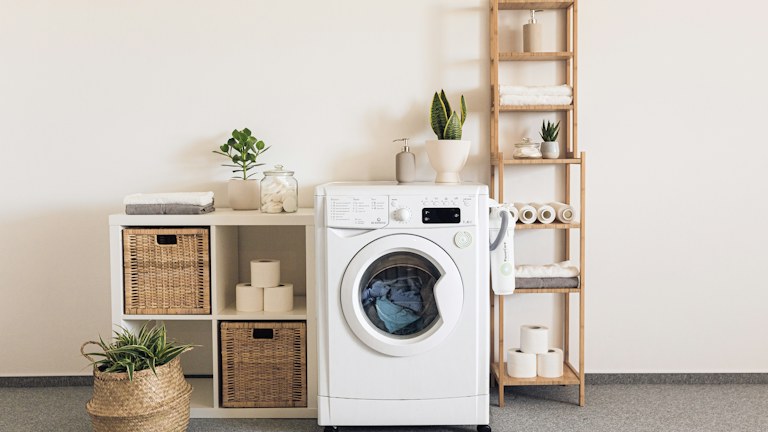
Photo: PlanetCare / Unsplash. Stock photograph for illustration.
In this guide
- Walk through one complete load
- Keep equipment access and instructions clear
- Give incoming clothes a clear destination
- Store supplies in their proper containers
- Plan drying before starting another load
- Create a finish point for clean clothes
- Separate repairs and unresolved items
- Review the arrangement after a few cycles
Laundry often becomes frustrating between the obvious stages. Clothes reach the machine but wait for somewhere to dry. Clean items are placed in a basket with nowhere to fold them. A missing button is noticed repeatedly but never reaches a repair pile. Organizing the space around the full journey of the clothes can address those gaps more effectively than buying another set of matching containers.
The space may be a separate room, a closet, a shared building facility, or one corner of a kitchen. The same planning approach applies: understand the sequence, respect the equipment's requirements, and give each ordinary task a clear place. This is an organization guide, not advice for altering plumbing, wiring, ventilation, or appliances.
Walk through one complete load
Follow a typical load from the place clothes are collected to the place they are put away. Notice where you pause, carry things twice, or put something down temporarily. Include sorting, checking care labels, washing, drying, folding, and returning items. The most inconvenient stage may happen outside the laundry area, such as a basket that never makes it upstairs.
Write down the two or three recurring obstacles. Be specific. No folding surface is easier to solve than laundry is chaotic. If several people share the work, compare their experiences. One person may struggle to reach supplies while another cannot tell whether a basket contains clean or unwashed items. A useful arrangement addresses the actual handoffs rather than only the appearance of the machines.
Keep equipment access and instructions clear
Before adding shelves or storage, read the appliance instructions for clearance, ventilation, access, and maintenance. Keep controls, doors, service points, and required airflow unobstructed. Do not use the top of an appliance as a storage surface unless the manufacturer's guidance permits the intended use. A tidy-looking arrangement is not an improvement if it prevents ordinary operation or inspection.
Keep the relevant manuals or official support links easy to find. Note the model information somewhere accessible without exposing private account details. If you discover leaks, damage, unusual operation, or uncertain installation conditions, arrange appropriate help instead of organizing around the problem. Storage choices should work within the equipment's requirements, not treat those requirements as empty space available for decoration.
Give incoming clothes a clear destination
Choose a collection arrangement that suits the household's actual sorting needs. You may need a simple shared hamper, separate baskets for particular care requirements, or a place for items awaiting a decision. Avoid creating so many categories that people cannot remember where things go. Care labels and the needs of the items should guide washing decisions, not a decorative label on a basket.
Make any distinction between clean and unwashed items unmistakable. Location, clear labels, or a consistent basket routine can help. If space is limited, one basket may serve several stages, but everyone needs to know how that works. A small ambiguity repeated every week can create more work than a modestly unattractive container that communicates its purpose clearly.
Store supplies in their proper containers
Keep laundry products in their original labeled packaging and follow the storage instructions. Attractive unmarked jars can remove directions and warnings that people need. Store products securely and out of reach of children and pets, using appropriate safeguards for your household. Do not place them in food containers or beside items that could make their purpose confusing.
Keep only the supplies you use in the immediate work area, with extras stored appropriately elsewhere if needed. Place frequently used items where the intended adult user can access them without awkward reaching. Avoid stacking products in unstable arrangements above the machines. The goal is an orderly, identifiable set of supplies, not a display that makes routine handling or safe storage more difficult.
Plan drying before starting another load
Look at the drying methods you actually use. Some items go into a machine according to their care instructions; others need a suitable rack or hanging space. Make sure the available arrangement does not block exits, circulation, appliance airflow, or access to essential fixtures. Follow the equipment and garment instructions rather than assuming one method suits every item.
If drying space is the bottleneck, adjust the schedule as well as the furniture. Starting several loads in quick succession may create a queue that no basket system can solve. A foldable rack can be useful where appropriate, but it still needs somewhere suitable to stand and somewhere to go when not in use. Plan both positions before buying it.
Create a finish point for clean clothes
Choose a clean, practical surface for folding or sorting finished items. It does not have to be permanently dedicated to laundry. A table used at a predictable time may work, provided it is cleared and suitable for the task. Keep the finish point close enough to the next destination that clothes do not become a long-term display in the laundry area.
Decide how items return to their owners or storage places. In a shared household, small labeled destinations may make the handoff clear. For one person, putting away a manageable load immediately may be simpler than maintaining several intermediate baskets. Choose the process you will use on an ordinary busy day, not the one that works only when the entire home is already organized.
Separate repairs and unresolved items
Give clothes needing a button, a label check, or another decision a small, distinct place. Write a short note if the problem will not be obvious later. Otherwise, the item may circulate through the same baskets without anyone remembering why it was set aside. Keep this category small enough that it remains a queue for action rather than hidden storage.
Set a realistic time to review it. Some items can be repaired, some need professional attention, and some may no longer be useful to you. Do not mix repair materials or sharp tools with ordinary laundry supplies where they create confusion or risk. The point is to move exceptions out of the normal flow while giving them a clear route back or onward.
Review the arrangement after a few cycles
Use the space for several ordinary loads before deciding it needs more equipment. Notice whether the original obstacles have improved and whether new ones have appeared. A shelf may be attractive but difficult to reach, or a sorting system may require more decisions than anyone wants to make. Adjust the smallest part that explains the problem.
Keep shared expectations visible and brief: where incoming clothes go, how clean items are identified, and who completes the final stage. Maintain the space according to the appliance instructions and the household's needs. A well-organized laundry area does not make clothes wash themselves. It reduces avoidable pauses and ambiguity so the necessary work has a clear beginning, a manageable sequence, and an actual finish.